
 2024-11-22
 PODCAST
 share
Would you trust a new malt batch or mash schedule without knowing how it will ferment? Brewing process modelling uses ingredient specifications, temperature logs and fermentation data to estimate wort composition before scaling a recipe. Brewing has evolved from ancient craft into a measurable bioprocess where sensor data and digital twin models support brewhouse decisions.
From empirical craft to brewing process modelling
Early brewers relied on observation to turn cereal starch into fermentable liquid. Controlled malting replaced guesswork by steeping barley in water to start germination, activating natural amylase enzymes and kilning the grain to preserve them. Once 19th-century science identified Saccharomyces yeasts as the organisms converting sugar into ethanol and carbon dioxide, brewers gained control over attenuation. Genomic research by Gallone and colleagues in Cell shows how reusing yeast sediment domesticated Saccharomyces cerevisiae beer strains to ferment malt sugars and reduce off-flavours.
Modern brewhouses connect five linked stages. Malting prepares the enzyme potential and colour of the grain. Mashing mixes milled malt with hot water so enzymes convert starches into maltose, glucose and maltotriose alongside amino acids for yeast nutrition. Boiling sterilises the wort and isomerises hop alpha acids, fermentation converts sugars into alcohol while releasing heat, and conditioning refines carbonation and flavour.
How mash and fermentation variables shape the batch
Small shifts in raw materials or temperature curves change the final beer. Adjusting the malt bill alters gravity and body, while water mineral balance affects mash pH and hop perception.
During mashing, temperature timing governs the balance between fermentable and unfermentable sugars. Kinetic mashing studies by Brandam and colleagues describe how holding the mash near 62 °C favours beta-amylase activity, breaking starch into simpler sugars that ferment into a drier beer with higher alcohol potential, whereas raising the rest toward 70 °C favours alpha-amylase and leaves more dextrins for a fuller body.
In the fermentation tank, yeast strain and temperature drive alcohol yield and aroma, making them core inputs for brewing process modelling. Top-fermenting Saccharomyces cerevisiae strains at 20 to 22 °C produce fruity esters, while bottom-fermenting Saccharomyces pastorianus lager strains, traced by Libkind and colleagues in PNAS to a cold-tolerant hybrid, ferment at 10 to 12 °C for a cleaner profile. Late hop additions and dry hopping preserve volatile oils without raising bitterness.
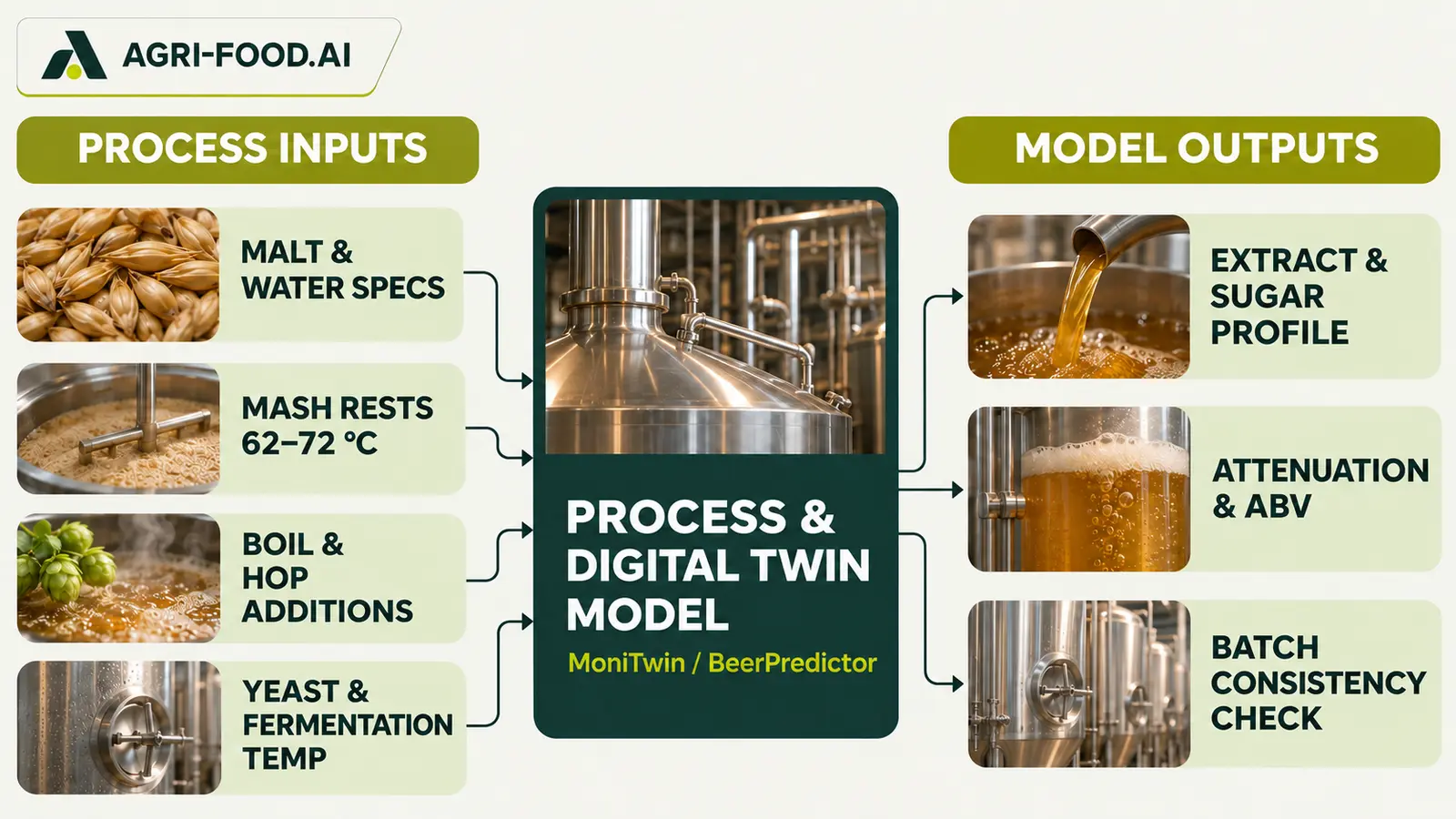
Brewing process inputs such as malt specifications, mash temperature steps and fermentation curves feed into digital twin scenario comparisons.What brewing process modelling can predict
Because mashing and fermentation follow measurable biochemical rules, brewing process modelling can estimate key batch parameters before a full production run. Mechanistic and machine learning models use malt analysis sheets, water chemistry, mash steps and yeast pitching data to project extract yield, wort fermentability and final gravity.
Dynamic fermentation simulation research by Rodman and Gerogiorgis shows both the value and the limits of these models. Models trained on consistent logs can estimate sugar conversion, temperature profiles and cooling loads, yet sensory aroma, foam stability and mouthfeel still depend on volatile interactions that require pilot brews and tasting panels. A model output is therefore a decision-support estimate rather than a replacement for lab checks.
In food and beverage manufacturing, AGRI-FOOD.AI developed the experimental BeerPredictor concept alongside MoniTwin to explore how digital twin technology and connected sensor technologies track mashing and fermentation variables in real time.
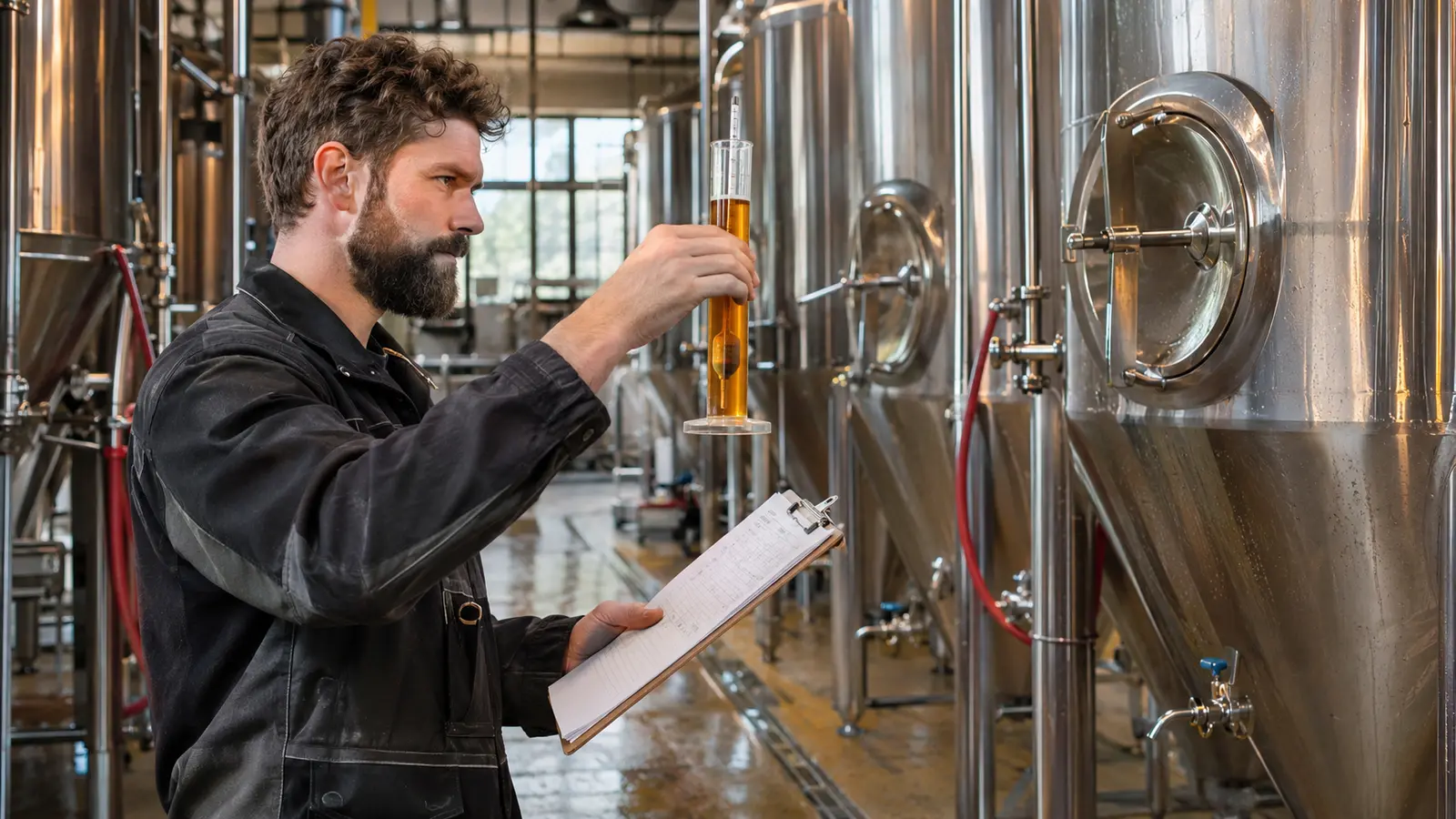
On-site wort gravity, pH and temperature checks validate model predictions against real brewhouse batches.How to test a digital twin workflow in your brewhouse
Introducing brewing process modelling starts with the records your brewery already collects across batches.
- Log malt lot analyses, mash step temperatures, pH values and wort gravity readings with consistent timestamps.
- Compare historical batch records against final attenuation, fermentation duration and cooling energy use to spot what drives variation.
- Validate any model prediction against lab wort and beer measurements on pilot batches before adjusting commercial recipes.
In our podcast episode below, Gergely Boromisza and agriculturalist Gergely Hankó discuss how experimental models connect raw material quality with production. Listen to the brewing and agriculture podcast episode.
To explore how MoniTwin or custom process modelling could support your line, contact AGRI-FOOD.AI with your process steps, sensor logs and the question you want to solve.
And don’t forget to stick with us week after week!. Connect with us online fill out the form on our website, and we’ll get back to you ASAP. Send us your questions, share your experiences, and we’ll turn them into podcast with answers and solutions from the world of IT and AI technologies. Catch us on Spotify, Apple podcasts and YouTube. Subscribe to our channel to be the first to know when a new episode drops.
2024-11-22


 Our website uses cookies